During the 2025 field season, thanks to Forested Landscape Priority Place (FLPP) funding, Island Nature Trust was able to look at the importance of forested features on agricultural lands, specifically in terms of our local avian species at risk. Rusty Bittermann and Margaret McCallum from Rustaret Farms kindly provided a testimonial to what forests mean to them and why they see value in retaining trees on their farm.
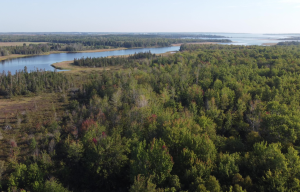
The 300 acres of Rustaret Farm straddle a high ridge in central PEI just to the east of the boundary line between Prince and Queen’s County. When we bought the properties that we now farm, we were drawn to the possibilities of the landscape. There were no buildings, lanes or fences, just a mixture of land in the potato rotation, pasture land growing over with forbs and brush, and woodland.
We saw many things that troubled us, including garbage dumped along field edges and streams, deep erosion gullies across steeply sloping fields, and streams damaged by field runoff. But we also saw the potential for a pasture-based cattle and sheep operation that would include forested land. And we saw an opportunity for ecological stewardship, as we employed techniques of restorative agriculture to improve the soil and enhance biological diversity.
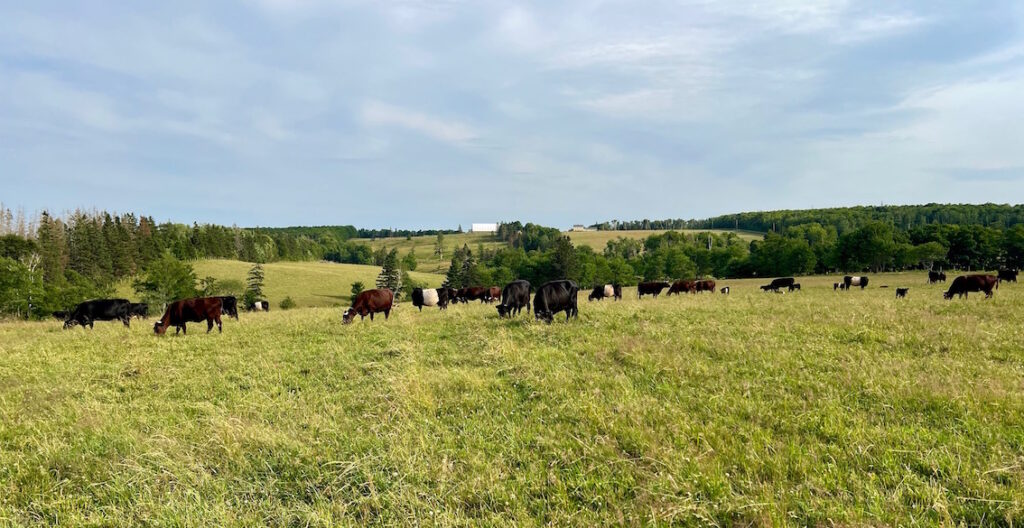
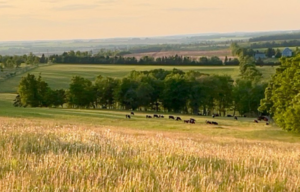
In the fifteen years since we acquired the farm, we have fenced two-thirds of the property, leaving a 100-acre woodlot for future plans. Our heritage livestock now rotationally graze more than a dozen fenced pastures, connected by farm lanes.
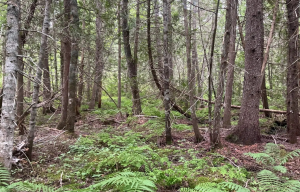
As much as possible, we included treed areas within our pastures, sometimes covering half the field, but usually strips along fencerows or small patches of woods that grew up in areas left uncropped by industrial agriculture. Some of the oldest and most interesting hardwood trees on the farm are in the old pastures and fencerows: big spreading beech, yellow birch, and sugar maple. Once our field fencing was in place (more than seven miles of it!), we began planting trees along the fences — ash and white spruce fronting on Highway #225, fruit trees along the half mile lane leading to the house, and red oaks, sugar maples, white pines, eastern hemlocks, butternuts, American chestnuts, and Carpathian walnuts elsewhere. We worked with Ducks Unlimited, the Bedeque Bay Environmental Management Association and the PEI Dept. of Agriculture to construct 11 ponds in the pastures, including a sediment trap on a tributary of the Dunk River.
The goals we articulated in our first business plan for Rustaret Farm included developing “a grass-based agriculture that combines nature conservancy, aesthetic beauty, and livestock breed diversity.” We are glad we wrote these things down as it is easy to succumb to pressures to make farm management decisions based on short-term profitability. We do not see nature conservancy and aesthetic beauty as necessarily at odds with productive farming practices (indeed to the contrary), but it is useful to remind ourselves of big picture objectives.
As we have struggled with heat and drought over the last several years, our efforts to preserve and enhance wooded areas in our pastures have provided our livestock with refuge from the sun. That most of our pastures now have natural sources of water also has practical implications for farming in a changing climate, when extreme weather can take out the power grid necessary for filling stock tanks. But beyond the practical, the ecological diversity of the landscape that we are tending brings us joy.
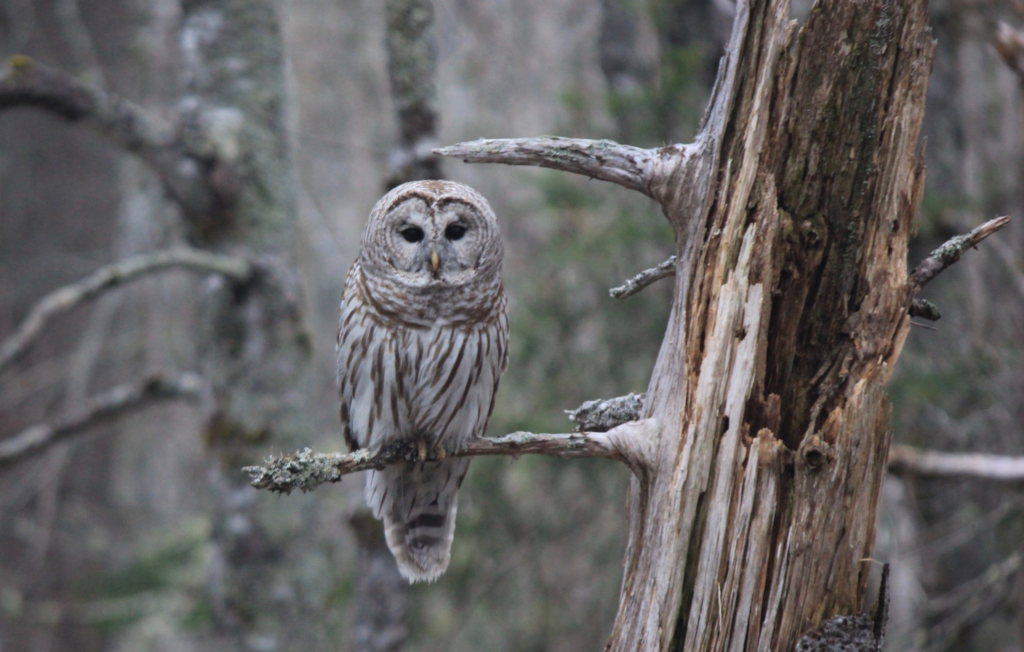
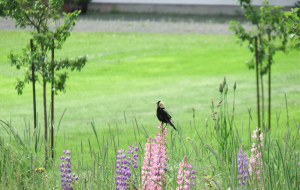
It is a rare morning that we do not see eagles and one or more of the six species of hawks that share the farm with us. The ponds draw geese, ducks, herons, kingfishers, killdeer, and various shore birds, as well as frogs and dragonflies. And then there are the dozens of species of other birds that we hear and see on our walks to check livestock in wooded pastures. We sometimes feel like hermits who seldom leave the farm, but our life here keeps us busy and entertained. As visitors note, maintaining healthy and diverse land and livestock is satisfying, soothing, and enormously interesting.
By Rusty Bittermann and Margaret McCallum
Rustaret Farms
Latest Articles
- Dog Leashing
 Here at Island Nature Trust, we are strong advocates for leashing our pets. Below are some key reasons why dog-leashing is so important for the environment and the health and safety of our four-legged loved ones.
 - Stewarding Your Coastal PropertyErosion Control Tips: Leave a buffer Mowing directly to the cliff’s edge can damage the structural integrity of the bank, and prevent deep roots from establishing, which can increase erosion rates.
- Seeing the Importance of Forest Features on Agricultural LandsDuring the 2025 field season, thanks to Forested Landscape Priority Place (FLPP) funding, Island Nature Trust was able to look at the importance of forested features on agricultural lands, specifically in terms of our local avian… Read more: Seeing the Importance of Forest Features on Agricultural Lands
- Analysis of a Surveyor’s Fieldbooks Tells Us a Lot About the Island’s Pre-settlement Forests
 A brief summary of Dr. Doug Sobey‘s (Research Associate of the Institute of Island Studies at UPEI) most recent work, the analysis of the fieldbooks of Alexander Anderson, the surveyor for Prince County from the 1830s… Read more: Analysis of a Surveyor’s Fieldbooks Tells Us a Lot About the Island’s Pre-settlement Forests
 - To Our Volunteers: Thank You
 This year has been an impactful and exciting one for our volunteer Guardian program. Many new Guardians joined a steadfast and committed group of existing volunteers, who continue to be of invaluable support to us.
 - Jumpstarting Forest Regeneration
 The majority of Island forests from tip to tip have had some degree of human disturbance, whether that be past agricultural use, intensive forest harvesting cycles, or habitat-altering plantations. These historic disturbances impact a forest’s natural… Read more: Jumpstarting Forest Regeneration
 - McNeill Family Donates Land to Honor Parents and Their Family LegacyThe McNeill family of Days Corner, PE, has made a generous 80 acre donation of land on the Ellis River. This property, which lies just outside of Wellington, is an ecological hotspot, with over a kilometer… Read more: McNeill Family Donates Land to Honor Parents and Their Family Legacy
- The Importance of ConnectivityPrince Edward Island is a mosaic of small, privately owned parcels, with high road density and a history of deforestation for farmland. These factors have created fragmented habitat for wildlife in the remaining forest and wetlands,… Read more: The Importance of Connectivity
- Local Farmers Committed to Bobolink Conservation
 The partnership between ALUS and Island Nature Trust has been one that has created a wonderful foundation for farmland bird conservation across Prince Edward Island. Local farmers are proving their commitment to wildlife by providing nesting… Read more: Local Farmers Committed to Bobolink Conservation
Latest Articles
- Dog LeashingHere at Island Nature Trust, we are strong advocates for leashing our pets. Below are some key reasons why dog-leashing is so important for the environment and the health and safety of our four-legged loved ones.
- Stewarding Your Coastal PropertyErosion Control Tips: Leave a buffer Mowing directly to the cliff’s edge can damage the structural integrity of the bank, and prevent deep roots from establishing, which can increase erosion rates.
- Seeing the Importance of Forest Features on Agricultural LandsDuring the 2025 field season, thanks to Forested Landscape Priority Place (FLPP) funding, Island Nature Trust was able to look at the importance of forested features on agricultural lands, specifically in terms of our local avian… Read more: Seeing the Importance of Forest Features on Agricultural Lands
- Analysis of a Surveyor’s Fieldbooks Tells Us a Lot About the Island’s Pre-settlement ForestsA brief summary of Dr. Doug Sobey‘s (Research Associate of the Institute of Island Studies at UPEI) most recent work, the analysis of the fieldbooks of Alexander Anderson, the surveyor for Prince County from the 1830s… Read more: Analysis of a Surveyor’s Fieldbooks Tells Us a Lot About the Island’s Pre-settlement Forests
- To Our Volunteers: Thank YouThis year has been an impactful and exciting one for our volunteer Guardian program. Many new Guardians joined a steadfast and committed group of existing volunteers, who continue to be of invaluable support to us.
- Jumpstarting Forest RegenerationThe majority of Island forests from tip to tip have had some degree of human disturbance, whether that be past agricultural use, intensive forest harvesting cycles, or habitat-altering plantations. These historic disturbances impact a forest’s natural… Read more: Jumpstarting Forest Regeneration
- McNeill Family Donates Land to Honor Parents and Their Family LegacyThe McNeill family of Days Corner, PE, has made a generous 80 acre donation of land on the Ellis River. This property, which lies just outside of Wellington, is an ecological hotspot, with over a kilometer… Read more: McNeill Family Donates Land to Honor Parents and Their Family Legacy
- The Importance of ConnectivityPrince Edward Island is a mosaic of small, privately owned parcels, with high road density and a history of deforestation for farmland. These factors have created fragmented habitat for wildlife in the remaining forest and wetlands,… Read more: The Importance of Connectivity
- Local Farmers Committed to Bobolink ConservationThe partnership between ALUS and Island Nature Trust has been one that has created a wonderful foundation for farmland bird conservation across Prince Edward Island. Local farmers are proving their commitment to wildlife by providing nesting… Read more: Local Farmers Committed to Bobolink Conservation