The majority of Island forests from tip to tip have had some degree of human disturbance, whether that be past agricultural use, intensive forest harvesting cycles, or habitat-altering plantations. These historic disturbances impact a forest’s natural resiliency, reducing its ability to withstand natural disturbance events. This past field season, INT’s Stewardship Team implemented ecologically focused forest interventions on three different forest plantations on our Farmington Woodlands Natural Area, located in Farmington, PEI, close to St. Peter’s Bay.
With the help of the PEI Wildlife Conservation Fund, we decided to implement treatments on three stands of a forest plantation. The interventions carried out on all three stands had the goal of improving wildlife habitat, promoting biodiversity, and improving the overall forest health by creating diverse forest structure, both vertically and horizontally. To accomplish this staff performed variable-density thinning techniques.
In conventional forestry operations, thinning is used to increase stand uniformity by reducing the stand density. Uniformity is achieved by removing trees with differing ages and height, and typically retaining only one species with even spacing between trees. Increasing uniformity optimizes forests for quality and yield which maximizes tree growth and product value. These traditional thinning techniques leave the stand with a simple structure, reducing value for wildlife and making it more susceptible to disturbance like disease outbreak and wind events. Variable density techniques increase spatial variability and promote under- and mid-story growth.
The design of our variable-density thinning treatment mimics natural forest disturbances. In the case of PEI, it is primarily wind disturbance. It is worth mentioning that forest regeneration is a natural process and will usually happen on its own over a longer period with no interventions. However, with the effects of climate change and increased severity of these natural disturbances at a higher frequency, landowners may wish to choose an accelerated diversification approach.
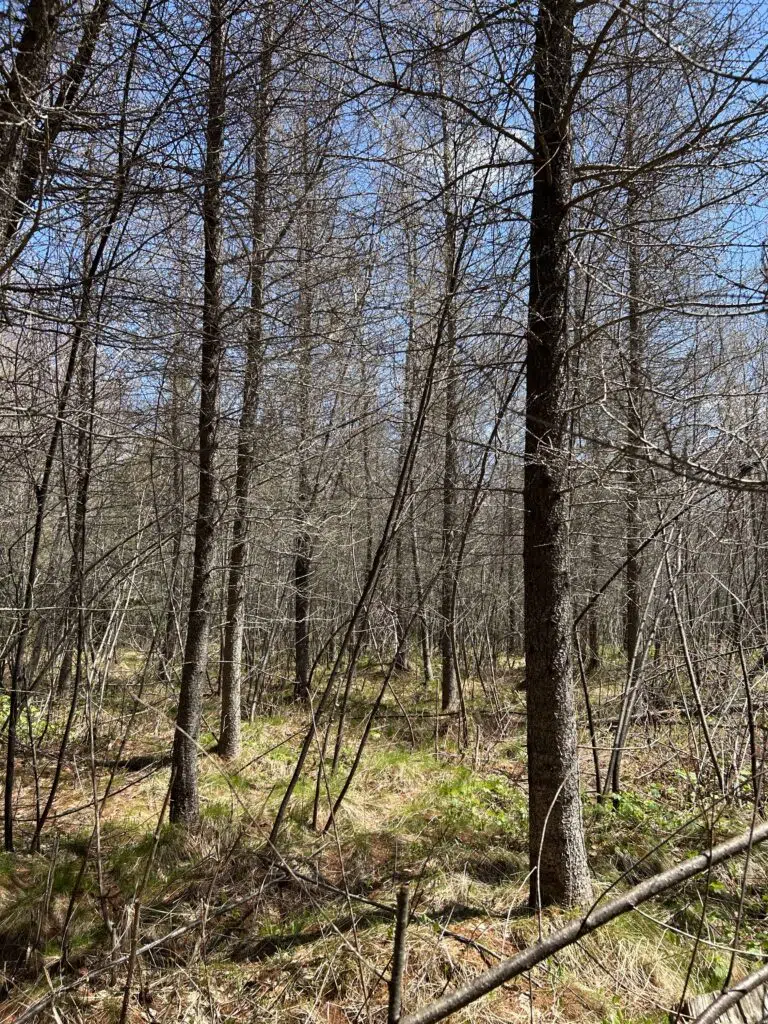
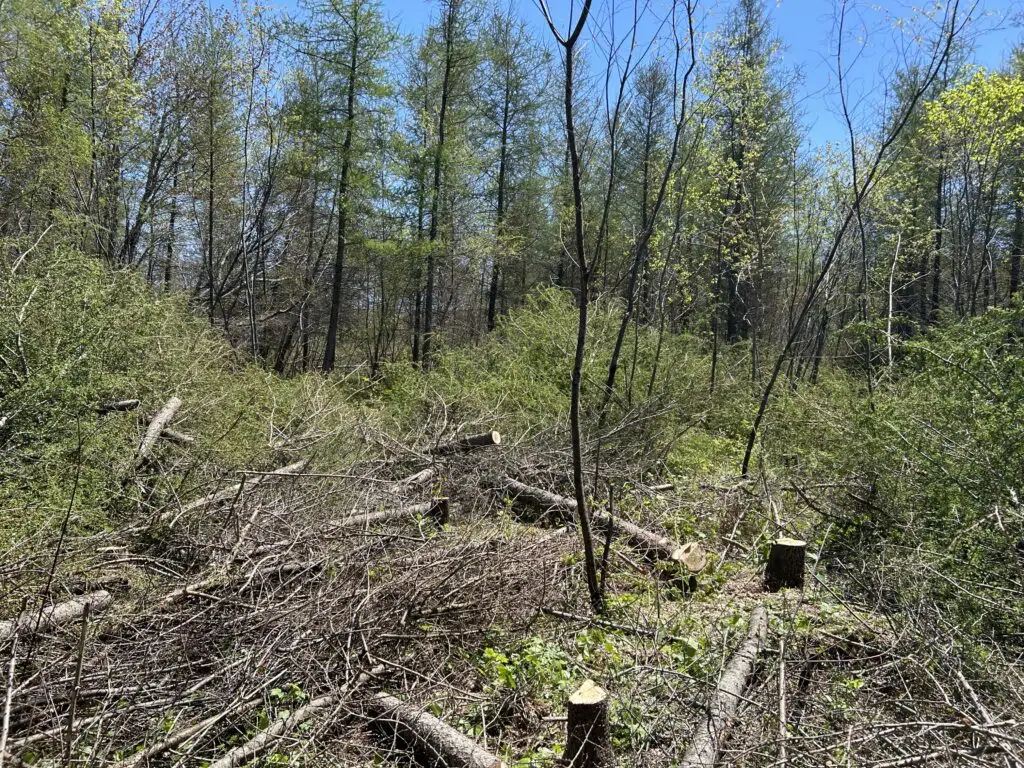
Thinning, if used in an ecologically focused way, is a good tool to jumpstart natural diversity in stands heavily impacted by human activity, creating complex microsites, helping foster resilience against an ever-changing climate. We used a variety of thinning techniques in our treatment sites to create a wide range of microsites across the stand, as would be seen in a healthy, resilient forest. The techniques used include:
Patch cuts – In our patches only the plantation species (in this case eastern larch/tamarack) were targeted for removal. We left all the underrepresented and more desirable species to occupy the new space, species like red maple, yellow birch, and chokecherry.
2-sided release and 4-sided release – In traditional forestry operations, the most valuable tree, termed “crop tree”, within an area is retained while all other trees near the crop tree are removed. This “releases” a tree by removing competition allowing it to maximize growth. Instead of exclusively selecting the largest or most valuable tree we selected a diverse mix of species, with priority given to ecologically significant species, to release. We further modified this traditional method by only selecting 2 or 4 sides to be released and by only removing our target plantation species, retaining the understory. This technique creates variability in species and structure in the stand on a microsite scale.
Skips – We chose sections of the stand to receive no interventions and be left to naturally cycle. These areas provide wildlife corridors, shade, and a seed source for the surrounding treatment areas.
Girdling – Trees receive nutrients through sap following through a layer known as the cambium just below the bark. Removing the bark and cambium layer of the tree cuts off nutrient flow to the leaves and roots, eventually killing the tree. This technique, when implemented in a ecological silviculture context, creates standing deadwood, eventually falling over, making natural gaps.
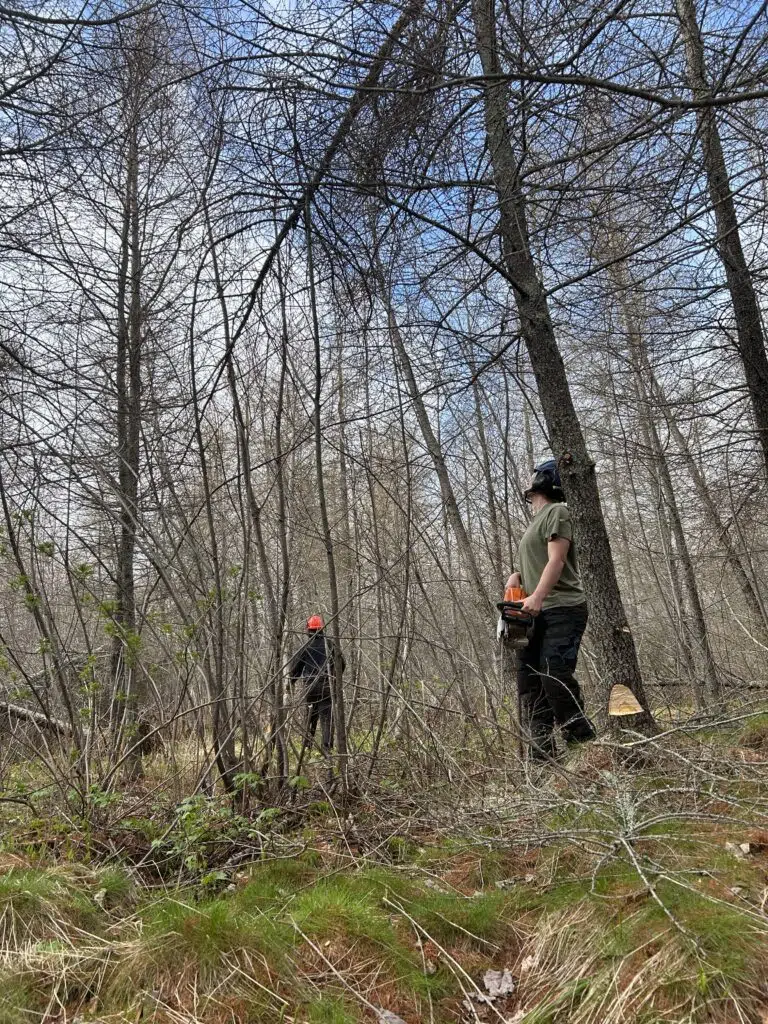
The limiting factor for tree growth is typically the amount of light available. These different techniques allow different amounts of light to reach the forest floor, which promotes differences in regeneration across the stand ultimately creating more complex forest structures. All wood was left on site to create wildlife habitat while the stands regenerate. Underplanting of desired species not present on the site was carried out to help quickly establish diversity.
Written by: Brittany MacLean Stewardship Coordinator